


Mica coarse carbon
Product overview: Yunwei New Material is a national high-tech enterprise committed to the comprehensive development and utilization of lithium resources, and is the only domestic enterprise that uses lime enhanced lithium carbonate hydrolysis process to build 10,000 ton battery grade lithium salt (including lithium hydroxide and lithium carbonate) to meet the standard in batch production.
Product keywords: lithium hydroxide, lithium carbonate
Classification:
Product Center

Hotline:
product details
Mica is the general name of layered aluminosilicates such as potassium, aluminum, magnesium, iron and lithium. Polymorphism is common, among which monoclinic system is common, followed by trigonal system, and others are rare.
Mica ore mainly includes biotite, phlogopite, muscovite, lepidolite, sericite, green mica, iron lepidolite, etc. The placer is a mixed mineral of mica and quartz. Muscovite and phlogopite are the most widely used in industry, and lepidolite is an important mineral raw material for lithium refining.
Mica is usually in the form of pseudo hexagonal or rhombic plate, sheet or column crystals. The color varies with the change of chemical composition, and darkens mainly with the increase of Fe content. Muscovite is colorless, transparent or light colored; The biotite is black to dark brown, dark green, etc; The gold mica is yellow, brown, green or colorless; Lithium mica is lavender, rose red to gray. Glass luster, pearl luster on cleavage surface. The Mohs hardness is generally 2~3.5, and the specific gravity is 2.7~3.5. The cleavage of the parallel base is very complete. Muscovite and phlogopite are widely used to make insulating materials in electronic and electrical industries because of their good electrical insulation, non thermal conductivity, acid resistance, alkali resistance and voltage resistance. Mica fragments and powders are used as fillers, etc. Lithium mica is also the main mineral raw material for extracting lithium.
Mica mineral characteristics
The main minerals of sodium mica pegmatite ore are microcline, feldspar, quartz and muscovite, and the secondary minerals are biotite, almandine, tourmaline, apatite, beryl and ilmenite. Apatite, tremolite, diopside, calcite, carbonate rock and microcline are often found in the veins of phlogopite deposits. The crushed fine muscovite deposit generally accounts for 50-70% of muscovite, about 10% of potassium feldspar and quartz, and the trace minerals are magnetite and limonite.
Mica belongs to aluminosilicate mineral with continuous layered silica tetrahedron structure. It is divided into three subtypes: muscovite, biotite and lepidolite. Muscovite includes muscovite and its subspecies (sericite) and rare sodium mica; Biotite includes phlogopite, biotite, iron biotite and manganese biotite; Lithium mica is the fine scale of various mica rich in lithium oxide. Muscovite and phlogopite are commonly used in industry, especially in electrical industry.
The chemical formula of mica is KAl2 (AlSi3O10) (OH) 2, in which SiO245.2%, Al2O338.5%, K2O11.8%, H2O4.5%. In addition, it contains a small amount of Na, Ca, Mg, Ti, Cr, Mn, Fe and F. The chemical formula of phlogopite is KMg3 (AlSi3O10) (F, OH) 2, in which K2O is 7 ~ 10.3%, MgO is 21.4 ~ 29.4%, Al2O3 is 10.8 ~ 17%, SiO2 is 38.7 ~ 45%, H2O is 0.3 ~ 4.5%, containing a small amount of Fe, Ti, Mn, Na and F.
previous
Micro powder lithium hydroxide
products
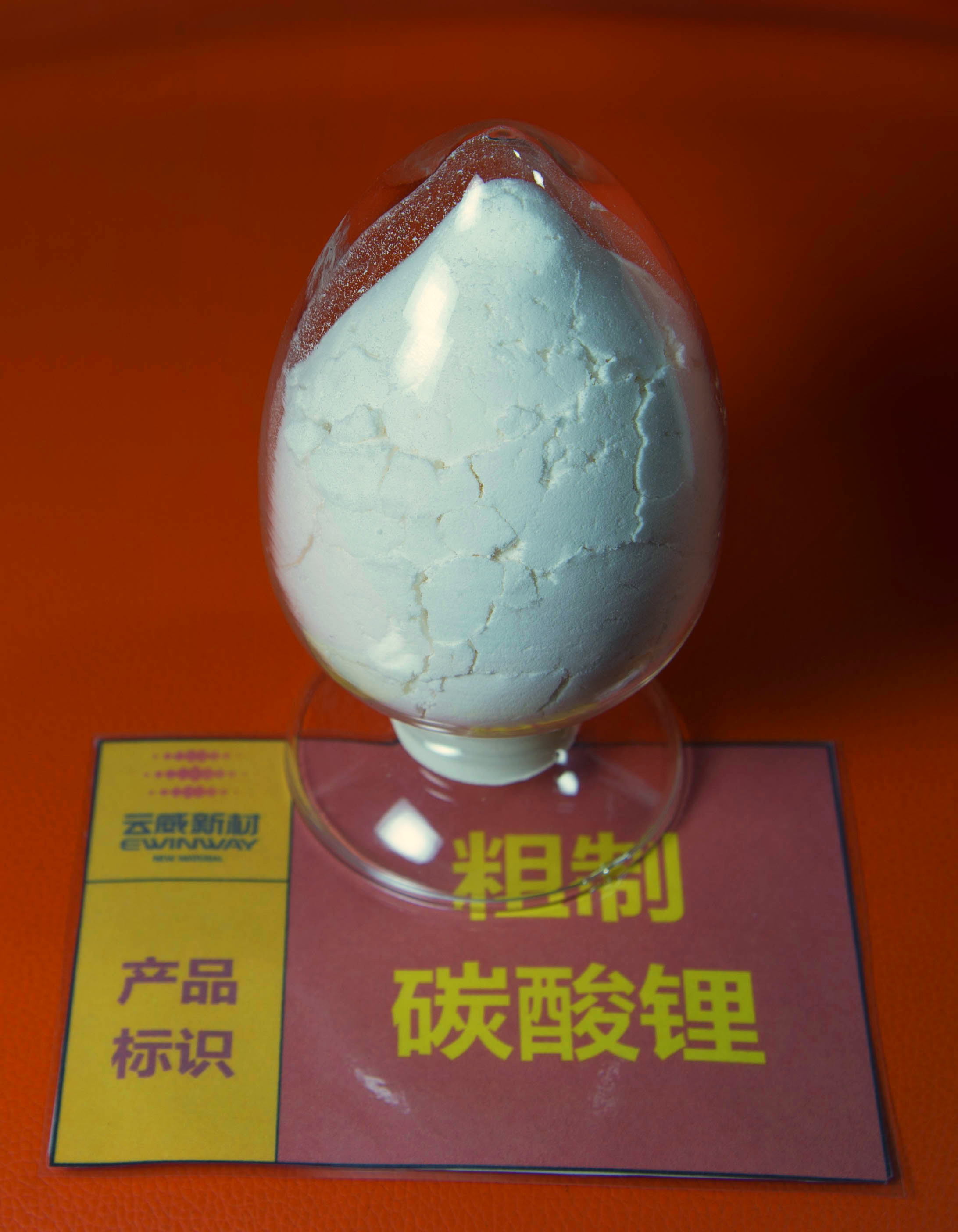
Crude lithium carbonate
Lithium carbonate is an inorganic compound, chemical formula Li2CO3, molecular weight 73.89, colorless monoclinic crystal, slightly soluble in water and dilute acid, insoluble in ethanol and acetone. The thermal stability of carbonate is lower than that of other elements of the same group in the periodic table, and it does not deliquescence in the air. It can be obtained by adding lithium sulfate or lithium oxide solution to sodium carbonate. The carbon dioxide in the aqueous solution can be converted into acid salt, which will be hydrolyzed after boiling. It is used as the raw material of ceramics, glass, ferrite, etc., and the components are sprayed with silver paste. It is used in medicine to treat mental depression.

Lithium carbonate
Lithium carbonate is an inorganic compound, chemical formula Li2CO3, molecular weight 73.89, colorless monoclinic crystal, slightly soluble in water and dilute acid, insoluble in ethanol and acetone. The thermal stability of carbonate is lower than that of other elements of the same group in the periodic table, and it does not deliquescence in the air. It can be obtained by adding lithium sulfate or lithium oxide solution to sodium carbonate. The carbon dioxide in the aqueous solution can be converted into acid salt, which will be hydrolyzed after boiling. It is used as the raw material of ceramics, glass, ferrite, etc., and the components are sprayed with silver paste. It is used in medicine to treat mental depression.

Crude carbon of recycled material
Carbon is a non-metallic element with the chemical symbol of C, which is stable at room temperature, difficult to react, extremely low toxicity to human body, and can even be safely ingested in the form of graphite or activated carbon. It is located in the IVA family of the second cycle of the periodic table.

Battery grade lithium hydroxide
Lithium hydroxide is an inorganic compound with the chemical formula of LiOH. It is a white crystalline powder, soluble in water, slightly soluble in ethanol, and strongly alkaline. The pH of 1mol/L solution is about 14, pKb=-0.04. It is mainly used to prepare lithium salts and lithium based grease, electrolyte of alkaline batteries, lithium bromide refrigerator absorption liquid, etc.
Provide you with solutions and prepare for your choices

ADD:No. 199 Xingye Road, Fengxin High tech Industrial Park, Yichun, Jiangxi
Tel:0795-4611988
Fax:0795-4588303
E-mail:yunwei@ewinway.cn
 hj@hjqp.cn ywj@hjqp.cn
 0795-4611988
 在线留言
在线留言


Follow official


